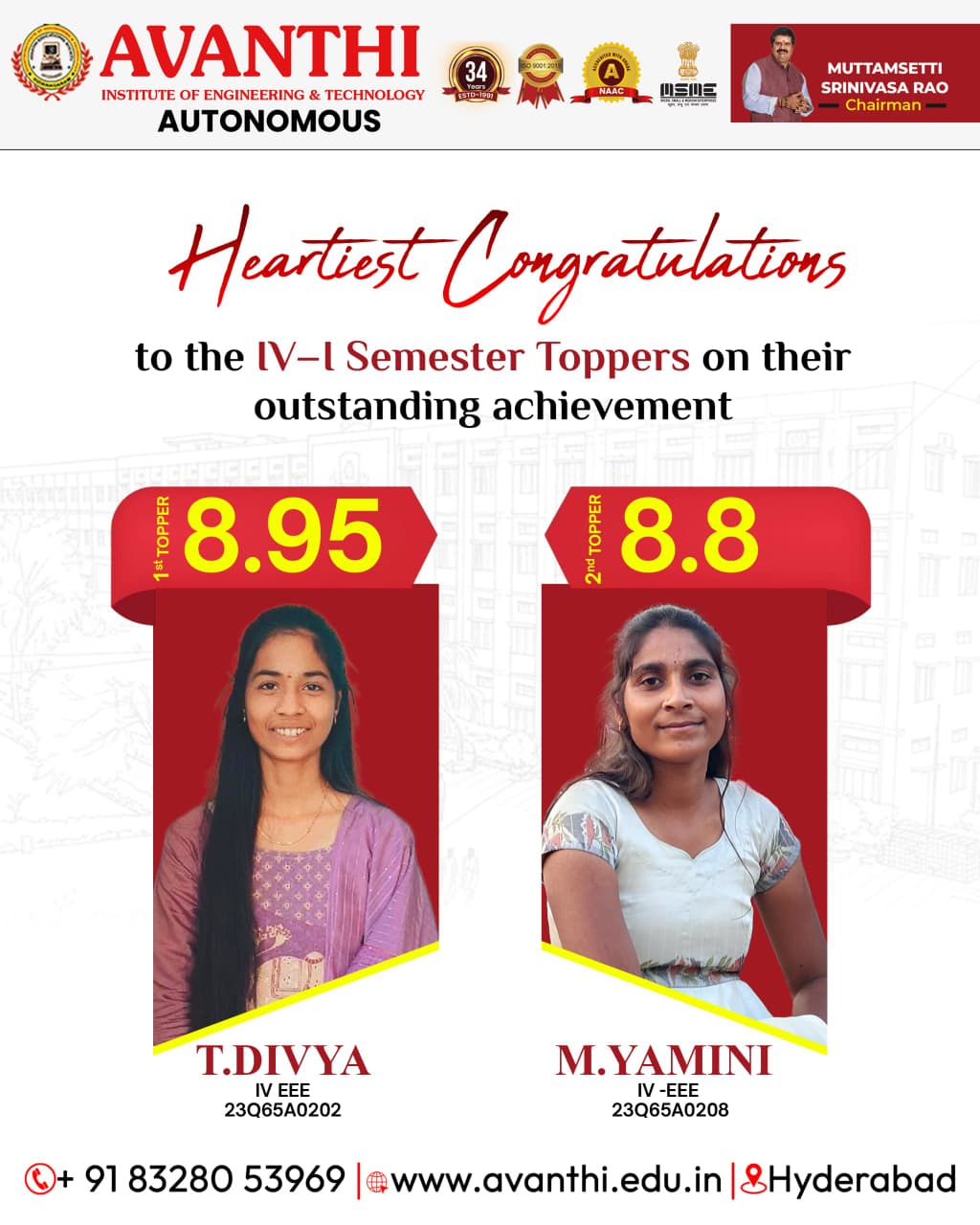
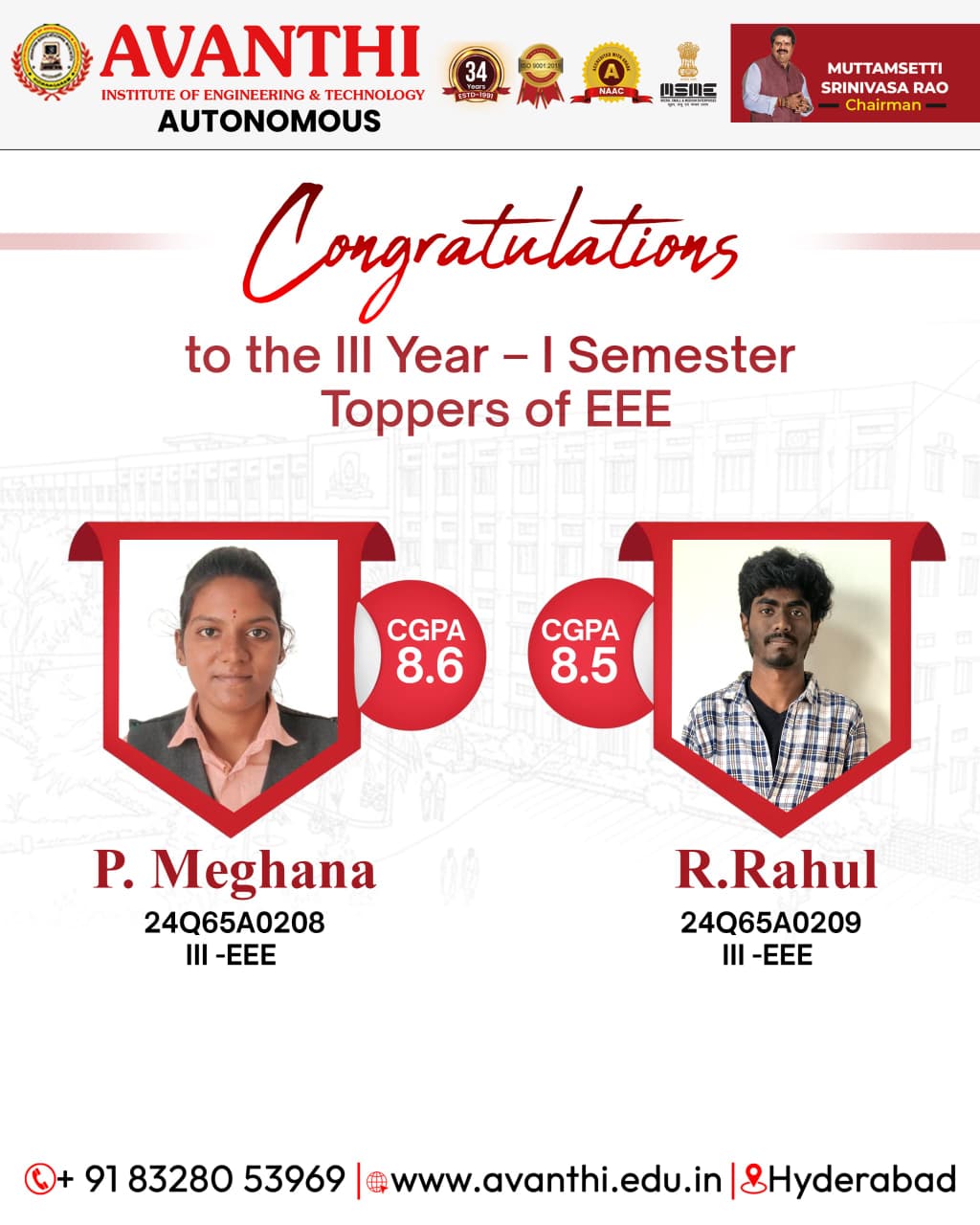
?v=1792018772)

WELCOME TO DEPARTMENT OF ELECTRICAL & ELECTRONICS ENGINEERING
The department of Electrical &
Electronics Engineering along with the ECE and CSE departments. The department has an intake of 60 students. "Starting from the academic year 2014, a post-graduate course in Electrical Power Systems was introduced. “The department has full-fledged laboratories, workshops and P.G. labs. "The department comprises highly qualified, experienced, and dedicated members who actively engage in researcg activities.
The department feels proud to have produced B. Tech graduates and M.Tech, many of whom are successfully employed in different areas in Electrical Engg. and Computer Applications. Some of them are pursuing higher studies in reputed institutions in India and abroad. The department with active support from the management is aiming to expand its research activities and industrial consultancies.
Vision of the Department
To become center of eminence in Electrical and Electronics Engineering through innovative, excellence in teaching, research and service.
Mission of the Department
M1: To offer high quality
education in Electrical and Electronics Engineering and to prepare students for
professional career or higher studies
M2: The department promotes
excellence in teaching, research, collaborative activities and positive contributions to
society
M3: To harness human capital
for sustainable competitive edge and social relevance.
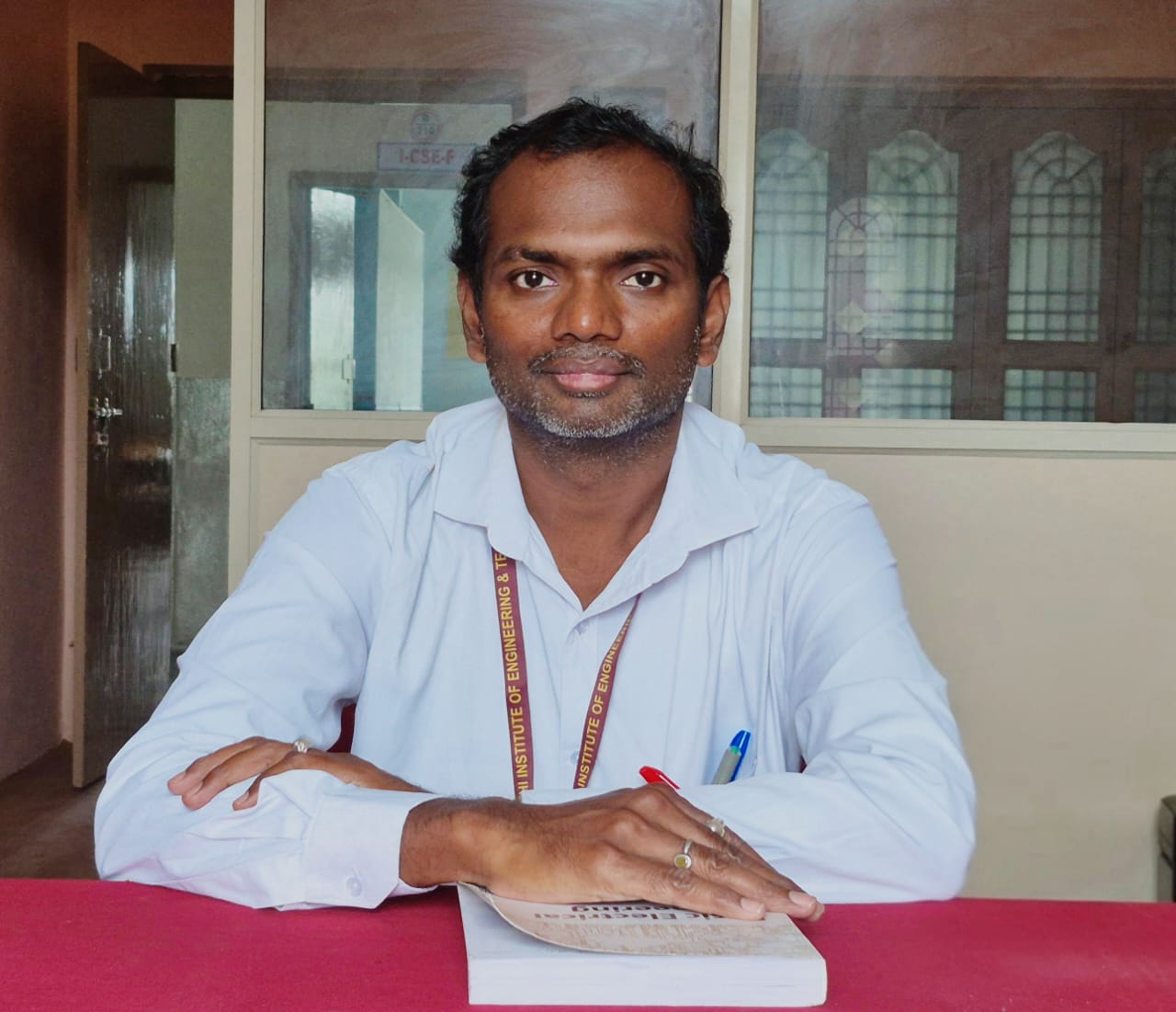
About Dr. T. Kranti Kumar
Dr. T.Kranti Kumar is currently working as Associate professor & HOD in Electrical and Electronics Engineering Department, Avanthi Institute of Engineering & Technology, Hyderabad, Telangana, India. He is having totally 18 years of teaching experience. His main research includes Power Electronics and Power Systems. He has published 23 papers in reputed national & international Journals. He has participated in different national & international conferences. He is having life membership of MISTE. He guided several UG & PG Projects.
Programs Offered
| ELECTRICAL & ELECTRONICS ENGINEERING | |||
| Branches | Name of the Courses | Seats | |
|---|---|---|---|
| B.Tech | Electrical & Electronics Engineering | 60 | |
| M.Tech | Electrical Power System | 24 | |
CO's, PO's & PEO's
PROGRAM OUTCOMES (POs)
Apply the knowledge of mathematics, science, engineering fundamentals, and an engineering specialization to the solution of complex engineering problems.
Identify, formulate, research literature, and analyze complex engineering problems reaching substantiated conclusions using first principles of mathematics, natural sciences, and engineering sciences.
Design solutions for complex engineering problems and design system components or processes that meet the specified needs with appropriate consideration for the public health and safety, and the cultural, societal, and environmental considerations.
Use research-based knowledge and research methods including design of experiments, analysis and interpretation of data, and synthesis of the information to provide valid conclusions.
Create, select, and apply appropriate techniques, resources, and modern engineering and IT tools including prediction and modeling to complex engineering activities with an understanding of the limitations.
Apply reasoning informed by the contextual knowledge to assess societal, health, safety, legal and cultural issues and the consequent responsibilities relevant to the professional engineering practice.
Understand the impact of the professional engineering solutions in societal and environmental contexts, and demonstrate the knowledge of, and need for sustainable development.
Apply ethical principles and commit to professional ethics and responsibilities and norms of the engineering practice.
Function effectively as an individual, and as a member or leader in diverse teams, and in multidisciplinary settings.
Communicate effectively on complex engineering activities with the engineering community and with society at large, such as, being able to comprehend and write effective reports and design documentation, make effective presentations, and give and receive clear instructions.
Demonstrate knowledge and understanding of the engineering and management principles and apply these to one’s own work, as a member and leader in a team, to manage projects and in multidisciplinary environments.
Recognize the need for, and have the preparation and ability to engage in independent and life-long learning in the broadest context of technological change.
PROGRAM SPECIFIC OUTCOMES(PSO’s
-
By the completion of Electrical and Electronics Engineering program the studentswill have following Program Specific Outcomes (PSOs):
- To analyze, design and develop electrical and electronics circuits by applying the fundamental concepts of Electrical and Electronics Engineering.
- To design, simulate and control the electrical and electronic applications using theconcepts of power and control engineering.
- To adapt emerging trends in electrical engineering with the aid of recent development in communication technologies, to innovate ideas and solutions toexisting/novel problem
Course Outcomes (CO's)
Faculty
| S.No | Faculty Name | Course |
|---|---|---|
| 1 | SATISH KUMAR MATHALA | EEE |
| 2 | SHANKAR MALOTHU | EEE |
| 3 | MADHAVI KAIROJU | EEE |
| 4 | Dr KRANTI KUMAR THALLAPALLI | EEE |
| 5 | RAGINI MALELI | EEE |
| 6 | VALLAMALA NAVANEETHA | EEE |
| 7 | BANAVATH SHANKAR | EEE |
| 11 | Dr SEELAM SRIKANTH REDDY | EEE OTHERS |
| 12 | EARATI PRASANNA | M.TECH EPS |
| 13 | Dr MANDADI SURENDER REDDY | M.TECH EPS |
| 15 | Dr MALLESAM DORA HANUMANTHU | M.TECH EPS |
| 16 | BANOTH KISHAN | EEE OTHERS |
| 17 | AVINASH PULIMAMIDI | EEE |
| 18 | NENAVTH RAMESH BABU | EEE |
| 19 | YALDANDI GIRIJA | EEE OTHERS |
| 20 | PALEM SARASWATHI | M.TECH EPS |
Labs in EEE Department:

BASIC ELECTRICAL ENGINEERING LAB

CONTROL SYSTEMS LAB

ELECTRICAL AND ELECTRONICS DESIGN LAB

MEASURMENTS AND INSTRUMENTATION LAB

POWER ELECTRONICS LAB

SIMULATION LAB
Short Term Goals:
- Placement of students in core companies
- Training the students to bridge the gap between industry and academia.
- Industry institute interaction.
- Continuous improvement in infrastructure and lab equipment.
- Interaction of faculty with outside world
Long Term Goals:
- Collaboration with foreign universities.
- Research projects with good publications.
- Continuous improvement in teaching learning methodologies